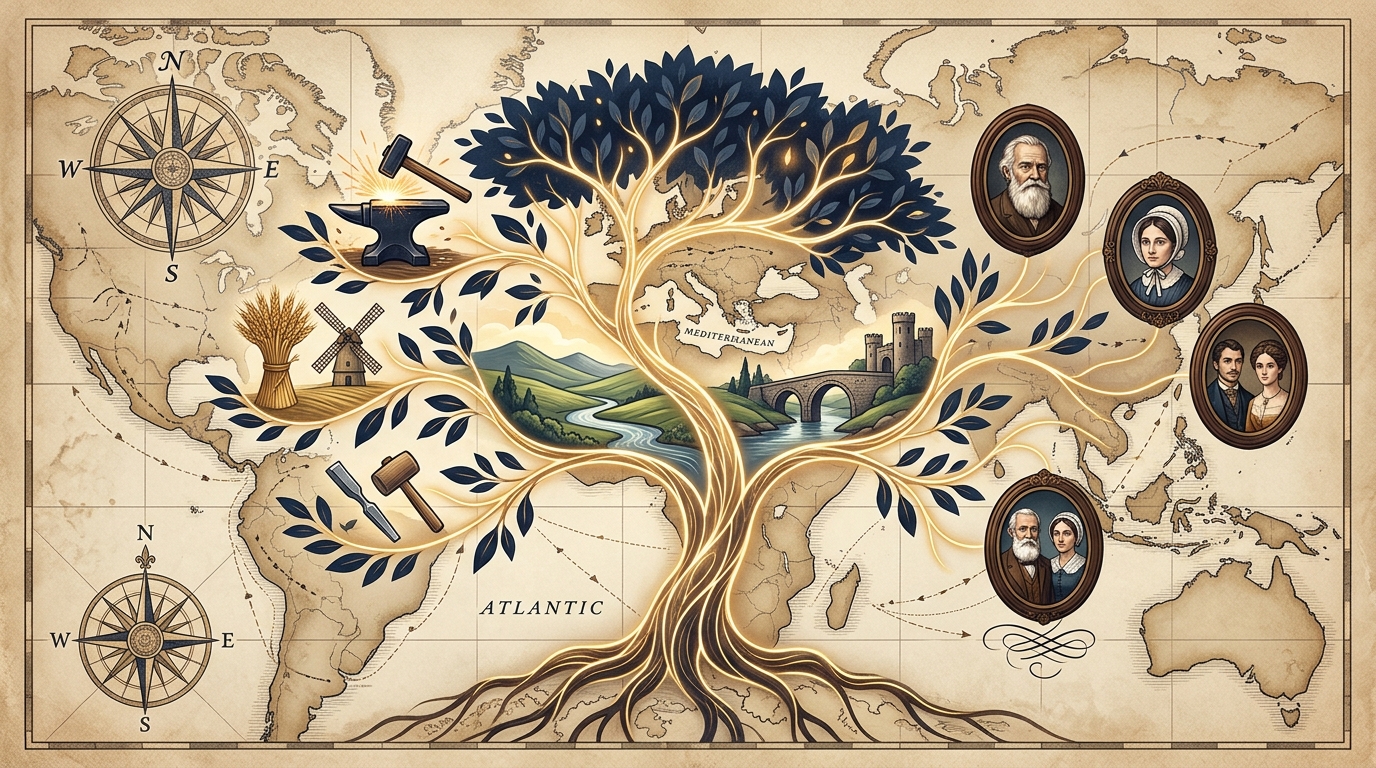
Every family name carries a story. Some surnames trace back to medieval occupations. Others point to a specific village, a physical feature, or a father whose first name became the family identity for generations. That last name printed on your birth certificate is not random. It is a compressed record of where your ancestors lived, what they did for a living, and how their community identified them.
Understanding the history behind your family name opens a window into your heritage that goes far beyond a simple label. It connects you to migration patterns, cultural traditions, and social structures that shaped entire populations centuries ago.
What Surname Origins Reveal About Family History and Ancestry
Before the Middle Ages, most people went by a single given name. As populations grew and communities expanded, a second identifier became necessary to distinguish between the many Johns, Williams, and Marys living in the same town. That second name eventually became hereditary, passed from parent to child and carried across borders and oceans.
The type of surname a family received depended on local customs, language, and social norms. English-speaking regions favored occupational and patronymic names. Scandinavian cultures used patronymic systems almost exclusively. Many Asian naming traditions placed the family name first, reflecting a cultural emphasis on lineage and collective identity over individual distinction.
Tracing the etymology of your last name can reveal which of these traditions your ancestors followed. That single piece of information often narrows down the geographic region, historical period, and social class your family originated from.
The Four Main Categories of Last Name Origins
Genealogists and linguists generally classify family names into four broad categories. Each type tells a different kind of story about the people who first carried them.
Occupational Surnames
These are among the most common and recognizable last names in the English-speaking world. Smith, Baker, Carpenter, Taylor, Mason, and Cooper all describe the trade a family practiced. A person called "John the Smith" eventually became "John Smith" as the label solidified into a permanent family name.
Other languages follow the same pattern. The German surname "Schneider" means tailor. The French name "Boulanger" means baker. The Italian name "Ferraro" refers to an ironworker. Recognizing these occupational roots often reveals both the ancestral trade and the country of origin in a single surname.
Patronymic and Matronymic Surnames
Patronymic names derive from the father's first name. Johnson means "son of John." MacDonald means "descendant of Donald." O'Brien means "descendant of Brien." The prefix or suffix changes across cultures, but the logic remains consistent. The child carries a name that identifies their parent.
Scandinavian countries used this system well into the 19th century. A man named Erik whose father was Lars would be called Erik Larsson. His sister would be Erik's sister Larsdotter. The surname changed with every generation until governments mandated fixed hereditary names.
Matronymic surnames, derived from the mother's name, are rarer but do exist. They sometimes indicate that a child was raised by a single mother or that the mother held particular social standing in the community.
Geographic and Locational Surnames
Many family names describe where a person lived or where they came from. Hill, Brooks, Atwood, and Underhill all reference landscape features. Lancaster, Worthington, and Berlin point to specific towns or regions.
These names often reveal migration patterns. A family named "Deutsch" living in England likely had ancestors who immigrated from a German-speaking region. A surname like "Lombardi" in a non-Italian country suggests roots in the Lombardy region of northern Italy.
Descriptive and Nickname Surnames
Some surnames began as physical descriptions or personality traits. Strong, Short, Armstrong, and Wise all fall into this category. The German name "Klein" means small. The French name "Petit" carries the same meaning. The Irish name "Kennedy" translates to "ugly head" or "helmeted head," depending on the interpretation.
These descriptive names offer a surprisingly personal glimpse into an ancestor. Someone earned that label through their appearance, behavior, or reputation, and the name stuck so firmly that it survived for centuries.
Curious about the story behind your own last name? Visit our website to explore a free surname lookup tool that traces the meaning, origin, and geographic roots of thousands of family names from around the world.
How Immigration Changed Family Names Forever
Immigration records tell a complicated story about surnames. When families crossed borders, their names often changed. Sometimes the change was voluntary. Immigrants anglicized their names to fit into new communities. "Schneider" became "Snyder." "Mueller" became "Miller." "Giannopolous" was shortened to "James."
Other times the change was accidental. Port officials and census takers who could not spell or pronounce foreign names recorded phonetic approximations. A single misspelling on an immigration form could alter a family name permanently, creating a new branch that looks unrelated to the original lineage.
These alterations make genealogy research both challenging and fascinating. Two families with seemingly different surnames may share a common ancestor whose name was modified at different points during migration.
Regional Patterns in Family Name History
Certain surname structures are so distinctive that they immediately point to a specific region. Names beginning with "Mc" or "Mac" signal Scottish or Irish heritage. The prefix "Van" or "De" suggests Dutch or Belgian roots. Names ending in "ov" or "ev" typically come from Slavic countries. The suffix "ez" in names like Rodriguez and Gonzalez indicates Spanish patronymic origins.
Asian naming conventions follow entirely different rules. Chinese surnames are drawn from a relatively small pool of about 400 common family names, many of which have been in continuous use for thousands of years. Japanese surnames often reference natural features like rice fields (Tanaka), mountains (Yamamoto), and rivers (Kawaguchi).
Recognizing these regional markers is the first step in tracing your ancestry through your family name. Even without formal genealogical records, the structure and sound of a surname can narrow down the search to a specific part of the world.
Tools and Methods for Researching Your Last Name Meaning
Online surname databases compile etymological research from linguistic scholars and historians into searchable formats. These tools let anyone type in a family name and receive information about its language of origin, historical meaning, and geographic distribution.
Census records and immigration archives add another layer of depth. Websites that host digitized passenger manifests, naturalization documents, and population surveys allow researchers to track when and where specific surnames appeared in historical records.
DNA testing services have added a modern dimension to surname research. While a last name suggests geographic origin based on linguistic evidence, genetic testing confirms or complicates that picture by revealing biological ancestry that may differ from the story the surname tells.
Common Misconceptions About Last Name Ancestry
One widespread myth is that all people sharing a surname are related. In reality, many common surnames arose independently in different locations. Multiple unrelated blacksmiths across medieval England all ended up with the surname Smith without any shared bloodline.
Another misconception is that a surname always reflects ethnic heritage. Centuries of marriage, adoption, and immigration mean that a person named "O'Connor" may have no Irish ancestry at all. The name could have entered the family through marriage three generations back.
Treating a surname as a clue rather than a conclusion is the right approach. It points researchers in a direction, but confirming the connection requires supporting evidence from records, documents, and sometimes genetic data.
Ready to uncover the history behind your family name? Head to our website now and use our free surname origin finder to discover the meaning, roots, and migration history connected to your last name. Start your search today and find out what your ancestors left in a name.
Conclusion
A last name is far more than a label on a mailbox. Understanding surname origins reveals connections to ancestral trades, homelands, family patriarchs, and physical traits that defined how communities identified one another centuries ago. Every category of family name, whether occupational, patronymic, geographic, or descriptive, carries a piece of history that links the present to a specific time and place in the past.
The tools available today make it easier than ever to trace these connections. A surname that seemed like nothing more than inherited paperwork can turn out to be a doorway into a rich family narrative stretching back hundreds of years. All it takes is asking the right question and knowing where to look for the answer.